How much meat is in a kebab? What the cone's meat content tells you
See what the meat content of a kebab cone says about yield and portion cost, and how to compare suppliers by specification before you look at the price list.
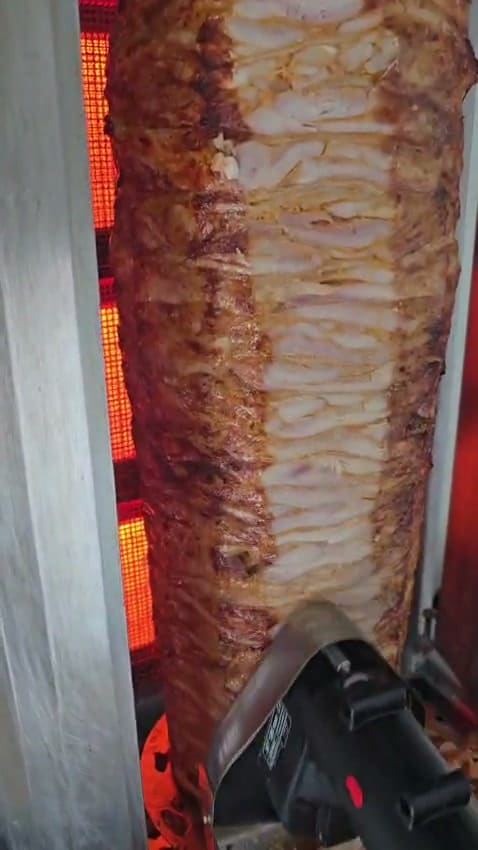
How much meat is in a kebab? Exactly as much as the producer declared in the product specification, because besides meat the cone also contains marinade, water and additives. That value means more to you than the price list, because it decides how many portions your customers’ outlets carve from every kilogram.
Key points in brief
- The meat content of a kebab is the share of meat in the finished product. The rest of the weight is marinade, water and additives.
- The producer declares this value in the product specification. Treat the lack of a written declaration as a warning sign.
- The less meat in the cone, the more water evaporates over the heating elements and the fewer portions are left on the tray.
- The price per kilogram of a raw cone says nothing about the cost of a portion. Compare suppliers by roasting trial batches in the same conditions.
What does the meat content of a kebab mean?
The meat content of a kebab is the share of meat raw material in the finished product, declared by the producer in the product specification. The rest of the weight falls to marinade, water and additives. The value differs between lines even within one plant, so ask about it separately for every line you take into your range.
The marinade is not a scam, because without it the meat would have neither taste nor juiciness. The problem starts when water replaces meat at the price of meat. You can’t see it on a raw cone; the difference only shows up on the spit.
What meat is in a kebab and where do you check it?
What meat is in a kebab is stated in the composition on the specification. The wholesale standard is chicken, turkey and their mix, alongside beef and combined variants. The species alone is half the information, because how the cone behaves on the spit also depends on the share of meat in the product.
We described the full supplier review in the article How to choose a kebab meat supplier.
How does meat content translate into yield and portion cost?
The mechanism always works the same way. Lower meat content means more water in the cone, the water evaporates during roasting, so less ready meat remains from a kilogram of raw product. That ratio is called the yield, and it is the yield, not the price per kilogram, that sets the real cost of a portion at your customer’s outlet.
Let’s run the numbers on made-up figures. Two cones both cost 20 per kilogram, in whatever currency you buy in. After roasting, the first keeps 70% of its weight and the second 60%. A kilogram of ready meat then costs around 28.60 from the first and around 33.30 from the second. At a 120 g portion the difference reaches 0.57, so an outlet selling 200 portions a day pays over 110 extra for the seemingly cheaper cone. The calculation is an example, but the mechanism works exactly the same in real outlets.
What should you check in the product specification?
The product specification is the document that lets you compare suppliers before you order the first carton. Ask for it separately for every line and check that it contains the complete set of information from the table below. A missing item means you’re buying blind.
| Item in the specification | What it tells you |
|---|---|
| meat content | how much of the product is meat and how much is water and additives |
| composition and raw material species | chicken, turkey, mix or beef, and what else went into the cone |
| cone weight | whether the product fits the grills at your customers’ outlets |
| form and storage conditions | frozen or chilled, at what temperature and for how long |
| plant’s veterinary approval number | which plant made the product and who supervises it |
| documents for the batch | whether certificates travel with the goods, for example Halal |
How to compare suppliers step by step?
The comparison takes two weeks and one session at the grill, and it sets your purchasing for months.
- Ask two or three suppliers for specifications of the same product type, for example a chicken cone.
- Reject offers without the meat content declared in writing.
- Order trial batches from the remaining suppliers.
- Roast the samples in the same conditions, ideally at one of your customers’ outlets, and weigh the ready meat from each cone.
- Divide the price per kilogram by the yield and compare the cost of a kilogram of ready meat instead of the raw cone price.
Write the results down for your next negotiations. We described the wholesale ordering process in the article Kebab meat wholesale: how to order in bulk?.
Meat content in 2Mundos cones
We are a kebab meat producer from Silesia. After 12 years of export our cones travel to 10 countries, and we state the meat content in the specification of every line and send it before the first order. Every batch ships with a Halal certificate, EU documents and the plant’s veterinary approval number PL 24094301 WE.
The range covers chicken, turkey and mix cones in three marinade lines, frozen and chilled, in cones from 10 to 50 kg. We sell wholesale to distributors and kebab wholesalers that resell the goods to outlets. Write through the contact form and give your volumes; the first conversation commits you to nothing.
FAQ: meat content in a kebab
How much meat is in a kebab from a wholesale cone?
Exactly as much as the producer declared in the specification of the given line, because besides meat the cone contains marinade, water and additives. There is no single value shared by the whole market, and the differences can be large. Ask for the specification of every line you buy and compare declarations between suppliers before you look at prices.
What meat is in a kebab sold wholesale?
The wholesale standard is cones of chicken, turkey and their mix, alongside beef and combined variants. You'll find the raw material species in the composition on the product specification, together with the share of meat in the product. Read both pieces of information together, because only their combination tells you how the cone will behave on the spit.
How many grams of meat in a kebab remain after roasting?
It depends on the meat content of the cone, the grill settings and the way of carving, so a single universal number doesn't exist. Only a test at your customer's outlet gives a reliable result. Roast a trial batch in the outlet's conditions, weigh the ready meat and count the portions per kilogram. That measurement goes into your portion cost calculation.
How do you check the meat content of a kebab before ordering?
Ask the supplier for a product specification with the declared meat content, composition and storage conditions. A reliable producer sends it before the first order and adds documents to every batch. Verify the declaration with a trial batch, because the weight of ready meat after roasting shows whether the paper matches the spit.